Piecewise-Focusing (PWF) Collectors
for high-temperature CST power and heat
RECENT WORK
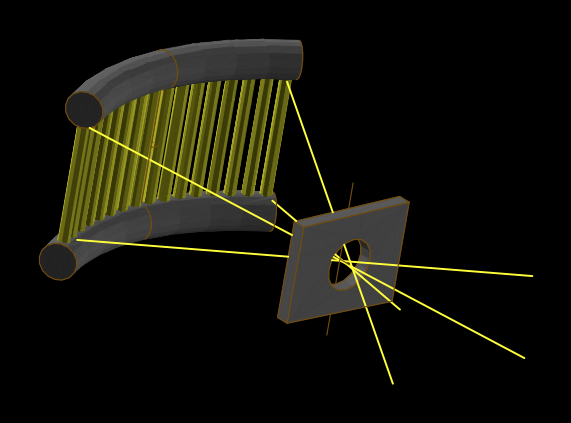
The Absorber
... is the region of the receiver that converts concentrated sunlight into useable heat, usually implemented as a bank of tubes carrying a heat transfer fluid. A cavity receiver is a bit like a pinhole camera, in that the illuminated absorber area follows the overall shape of the face of the collector. Earlier PWF work using a paraboloidal face (circular aperture) therefore needs a roughly circular (radially symmetric) absorber, e.g. the inside of a cone or section of a sphere. Implementing this absorber as a bank of tubes with inlet and outlet manifolds would be a plumber's nightmare. The face shape of the "Physical model with planar face" is a rounded rectangle, so the absorber should also be roughly rectangular (not necessarily planar). This can readily be implemented as a 'billboard' absorber inside the cavity, possibly with cylindrical curvature as shown above.
Spherically-curved Reflectors
During early stages of PWF collector conceptualization and design it was assumed that each reflector would be curved three-dimensionally such that it would be perfectly focused on the receiver entrance at a selected sun elevation, i.e. the curvature of each reflector would be customized and different from the others -- probably expensive to manufacture. What if reflectors are all made with spherical curvature? Mass production would be much cheaper. And since the best radius of curvature depends on the distance to the receiver, how many different radii of curvature would be needed across the whole array of reflectors?
The first three images below show some results for spherical reflectors at the indicated sun elevations. Each small circle represents a ray reflected from the centre or six vertices of each of the eight reflectors of the "Physical model with planar face", allowing for spread caused by the finite size of the sun, but with no allowance for random errors in mirror shape. Three different radii of curvature were used across the eight reflectors. The large dashed circle represents the receiver entrance. The two further images are corresponding results from reflectors with custom curvature; the 'perfect' result at 40 degrees elevation is not shown.
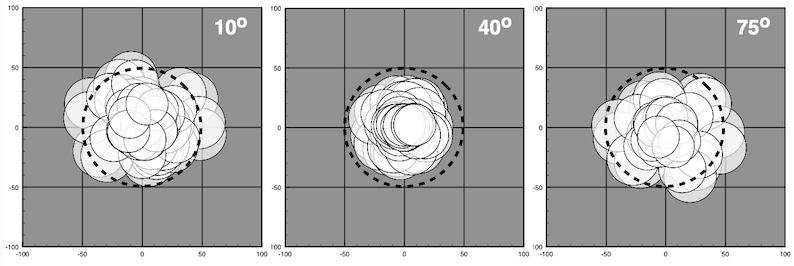
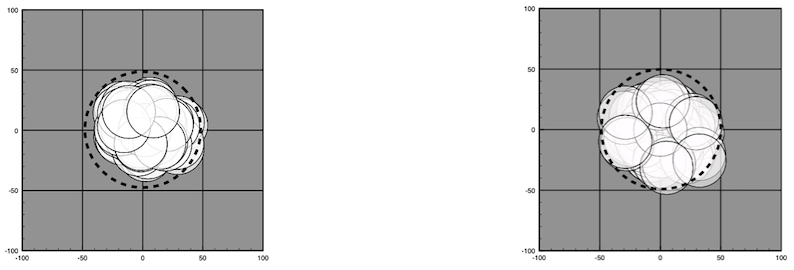 The use of spherical reflectors does degrade reflector focus to a moderate extent, although only a few 'worst case' reflectors actually cause the visible spillage. However, this can be mitigated by using a greater number of relatively smaller reflectors, e.g. 250 instead of 90 reflectors on the whole collector front face. For a total collector area of 5000 m2, each reflector would be 5000/250 = 20 m2, probably a good size for manufacturing.
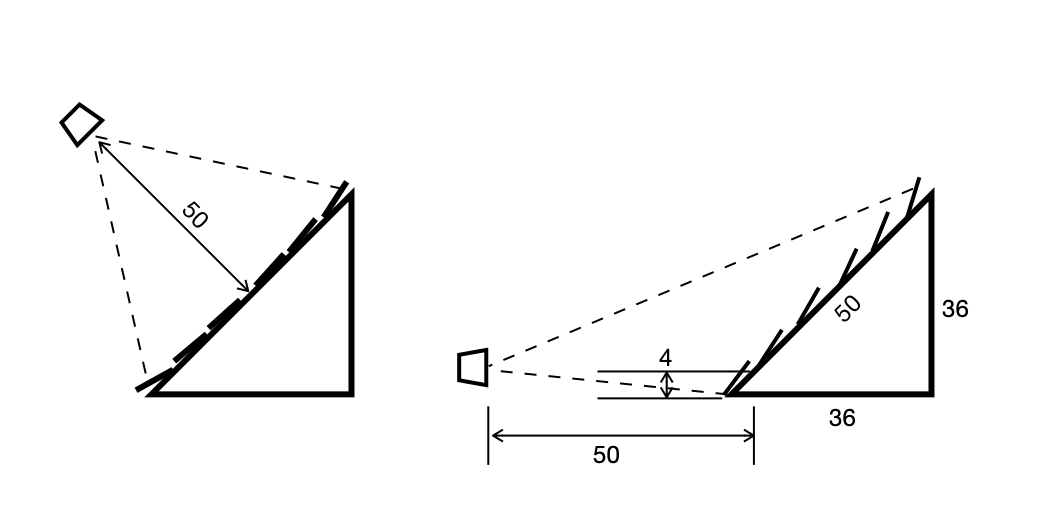
PWF Design for Photothermal Materials Processing
So far it has been assumed that PWF collectors will be used to heat a suitable heat transfer fluid, and that there's no impediment to mounting the receiver perpendicularly above the centre of the collector face, as sketched above left. The 5000 m2 collector mentioned above, with a 100 x 50 m front face, will have its receiver 55-60 m above ground level. However, the potential for using highly concentrated sunlight directly for materials processing has long been recognized, and in these cases it's likely to be much more convenient to have the receiver set close to the ground, as sketched above right. This study on a PWF collector for photothermal materials processing shows that such an arrangement is feasible.
Updated March 2026.
*****************