Piecewise-Focusing (PWF) Collectors
for high-temperature CST power and heat
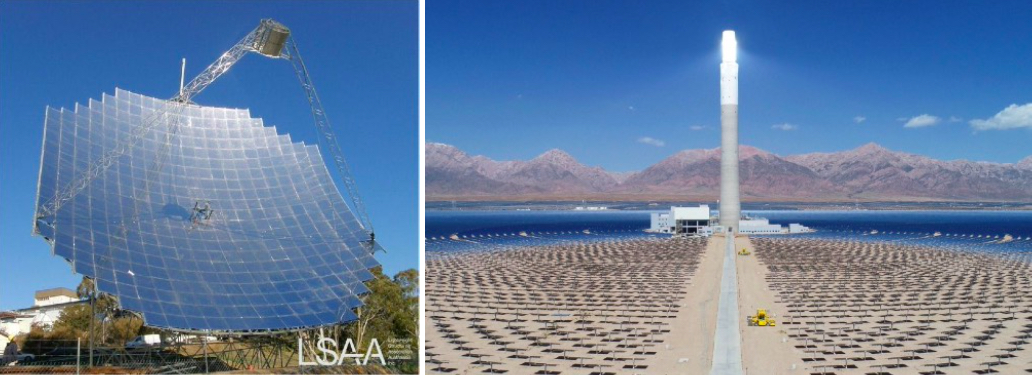
ANU SG4 paraboloidal dish, and Supcon Delingha 50 MW 'power tower'
Context:
At temperatures above 350 or 400 C, solar heat for power generation or industrial processing is best supplied by point-focus systems. So far, such systems have been based on heliostat fields focused on tower-mounted receivers, or based on paraboloidal dishes, though the latter are too expensive at large scale despite their much greater efficiency. The PWF collector is a point-focus CST (concentrating solar thermal) design that combines the best aspects of heliostat fields and paraboloidal dishes.
Analyses of the concept and its performance have been published in two ASME Journal papers and four conference papers.
1. Concept sketch
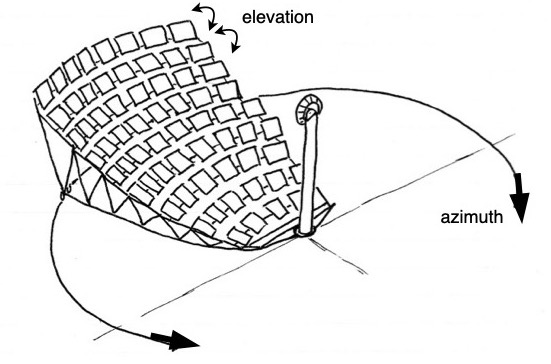
A base-frame rotates on a horizontal track to follow the sun in azimuth. Multiple reflectors are mounted on the base-frame via simple, precisely-oriented axes, about which they are tilted to follow the sun in elevation. The reflected sunlight is focused into a cavity receiver at high concentration.
Key points:
- Single-axis mounting of each reflector does away with the expensive two-axis drives required for heliostats.
- The reflectors are much better oriented towards the sun than heliostats, which are often very oblique to the sun.
- The base-frame stays on the ground, unlike paraboloidal dishes that have to be raised in the air like giant sails, which severely limits their size.
2. Compact version with paraboloidal face
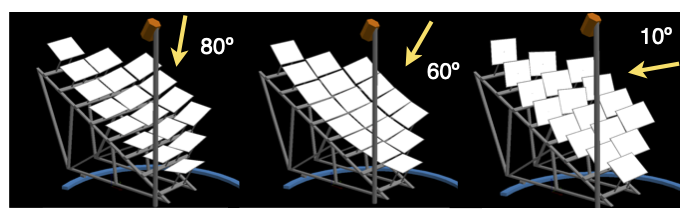
Initial PWF designs included an overall paraboloidal shape, circular aperture, 30-degree tilt towards the sun, and a cavity receiver. Only the right-hand half of the collector is shown in this simplified CAD model, with three sun elevations indicated. Analytical expressions were developed for collector efficiency as a function of sun elevation, and used in the NREL System Adviser Model.
3. Physical model with planar face (geometry tests)
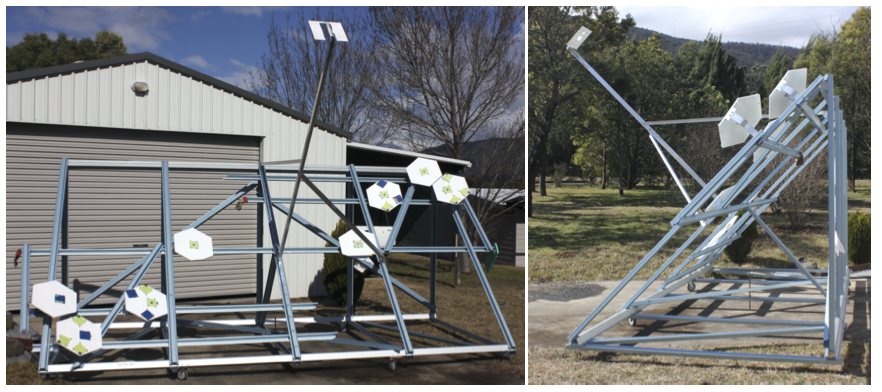
This model has a steel frame (stiff and lightweight), a flat front face 5.8 x 2.9 m at 45-degree slope, and a flat target 2.9 m above its centre. The model has eight hexagonal plywood ersatz reflectors with central mirrors; four hexagons (difficult cases) have secondary mirrors at several vertices. About 90 hexagons would be needed for full tessellation of the collector face.
Sun-tracking is carried out by two different mechanisms in PWF collectors, which greatly simplifies the process compared to the complicated two-axis tracking required for heliostats or dishes.
The base-frame does the azimuthal tracking [video above], while individual reflectors track the sun in elevation [video below].
Wind and gravity loads are mainly carried by the central pivot or reflector tilt bearings respectively, and therefore tracking effort is quite small. Here is an example of three reflectors tilting to track the sun [slides] throughout the day, as their reflections of the sun hit the target. Movement of the base-frame can be inferred from the changing background.
4. Numerical model (Fortran programs) of reflectors and target
Results from these Fortran numerical models agree quite well with results from the physical model above and other physical experiments. Rapid exploration of various reflector shapes, sizes and layouts can be undertaken. For example, the ideal reflector shape is a section of a paraboloid, different for each reflector (possibly expensive to manufacture), but modelling shows that focus results are satisfactory with spherical reflectors of 3 or 4 different radii of curvature, better suited to mass production. See the Calculations page for links to some of the programs.
5. First prototype
A first prototype is projected to be about double the size of the physical model (3, above), and operated under computer control for azimuth and elevation. It is to be equipped with about 20 hexagonal reflectors fully covered with curved mirrors, of a size such that 120 reflectors would fill the planar front face. The target will consist of a plate in the focal plane with an opening representing the entrance to a cavity receiver, and a larger board behind it representing the absorber section of the receiver (but readily visible in this case). Dr Bisset does not have the skills and resources to build this prototype himself, and therefore he welcomes any offer of collaboration from organizations with the necessary capabilities and/or financial resources.
Some advantages of PWF collectors
- Modular
- Efficient use of reflector area (small cosine losses)
- Stiff lightweight base-frame construction
- Low-cost off-the-shelf linear actuators
- Cavity receiver
Dr David K Bisset
Contact email: david.bisset@pwfcollector.au
Updated Jan 2026.
*****************